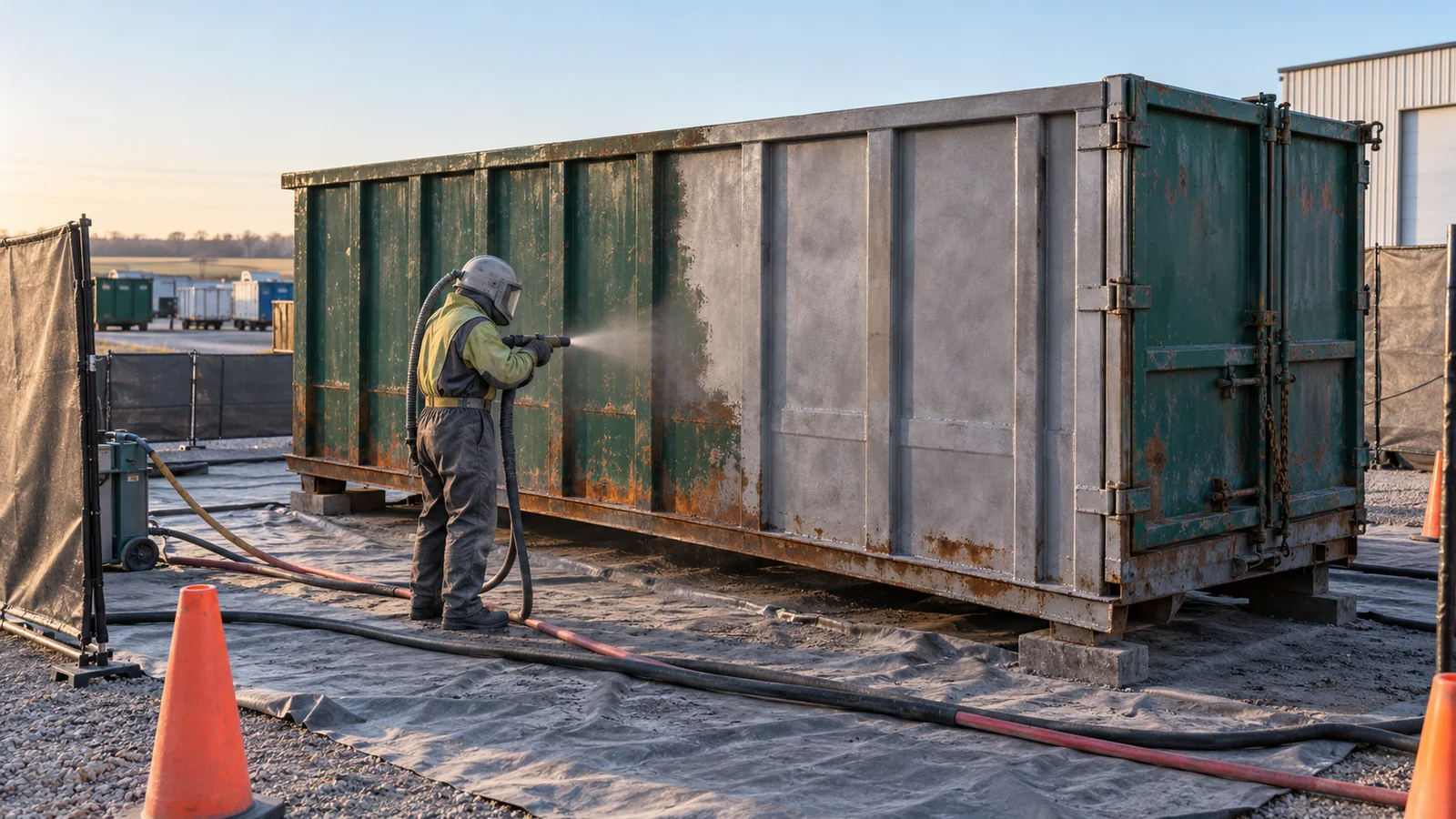
A roll-off container earns its damage one pickup, drop, load, and landfill trip at a time. Abrasion removes coating from rails and ribs. Impacts deform panels. Moist material sits against the floor. Road salt and wash water collect around welds. A quick coat of paint may improve the color, but it will not correct contamination, loose coating, hidden corrosion, or a surface profile that does not match the new coating.
Effective roll-off container surface preparation treats every box as both a steel structure and a working fleet asset. The job starts with an empty, cleaned, released container; a condition survey; and an agreed coating system. It continues through a representative test area, repairs, controlled preparation, inspection, primer, and a documented return to service.
This guide applies to exterior preparation and to open-access interior areas only when the owner has confirmed that a container is empty, clean, safe, and released for the work. It does not cover entering a container, handling unknown waste, or servicing powered compaction equipment.
Define the Container Types and Service Conditions
“Dumpster” can describe very different assets. A roll-off box serving a construction site does not age the same way as a front-load container behind a restaurant, a scrap-metal box, or a receiver container connected to a compactor. Record the type, capacity, manufacturer, service, and coating history before building a scope.
A useful inventory includes:
- asset number, yard location, normal route, and customer assignment;
- roll-off, front-load, rear-load, hook-lift, receiver box, or specialty body;
- approximate age, manufacturer, material, and known repair history;
- typical contents and whether regulated, corrosive, oily, or biologically contaminated material has been carried;
- floor, sidewall, roof, door, lid, hinge, rail, roller, and lifting-point condition;
- coating layers, rust pattern, decals, reflective markings, and identification plates;
- areas that must remain uncoated or receive a specific coating thickness;
- preparation, repair, primer, finish, cure, and acceptance requirements.
Service environment matters. A container exposed to wet food waste, fertilizer, concrete washout, road salt, scrap impact, or long-term outdoor storage may require a different cleaning, testing, and coating plan. The owner should identify contents honestly so the contractor can decide whether the project is within scope.
Take the Container Out of Service Safely
Deliver the box empty, cleaned, dry enough to inspect, and separated from collection operations. Remove it from dispatch and mark its status so a driver cannot collect or exchange it while people are working around it. Stage it level on a stable surface with owner-approved support and enough clearance for safe access, containment, inspection, and coating.
No preparation should begin while the container is on a truck. Secure swing doors, lids, and other moving parts against unintended movement. Keep workers out of the container unless the owner has completed a separate hazard assessment and established the access, ventilation, rescue, and work procedures that may apply. This article does not treat a box as an authorized entry space.
Receiver boxes and self-contained compactors require extra separation between container work and machine work. If servicing could expose employees to unexpected start-up or stored energy, OSHA's control of hazardous energy standard requires an energy-control program and procedures. The owner and authorized employees—not the blasting crew by assumption—must isolate, verify, and release affected equipment.
Clean Before Abrasive Preparation
Abrasive blasting is not a substitute for waste removal, washing, degreasing, or decontamination. Residue can hide defects, contaminate abrasive, spread across clean steel, and interfere with coating adhesion. Unknown material also creates an unknown exposure and waste stream.
The owner should remove all contents and arrange cleaning appropriate to the container's service. That may include scraping by qualified personnel, pressure washing, detergent cleaning, degreasing, rinsing, and controlled drying. Wash water and removed material must be managed under the owner's site and environmental requirements; they should not simply flow into a storm drain or across the yard.
Reject or hold a unit when residue, odors, liquids, sharps, biological material, labels indicating hazardous contents, or unidentified material remain. A photograph cannot establish that a container is safe. The release should be based on the owner's records, cleaning process, and site-specific evaluation.
Inspect Steel, Welds, Doors, Rails, and Lift Points
Photograph all sides before disturbing the coating. Then inspect the floor and lower walls, top rail, vertical ribs, understructure, long rails, rollers, door frame, hinges, latches, lid hardware, tarp hooks, pickup points, and major welds. Look for perforation, section loss, cracking, bent members, torn welds, trapped debris, standing water, and previous patches.
Separate a coating problem from a structural or operating defect. Blasting can expose thin metal and failed repairs, but it does not restore steel thickness or certify that lifting components are safe. The owner or a qualified repair provider should decide what must be repaired and whether the container remains serviceable.
Create hold points for conditions that can change the scope:
- corrosion-through or broad floor thinning;
- cracked, incomplete, or separating welds;
- damaged rails, rollers, hooks, lifting eyes, or pickup pockets;
- doors or latches that cannot be safely secured;
- large deformations that prevent consistent coating access;
- incompatible patches, sealants, grease, or fire-damaged coating;
- markings or plates that cannot be removed, masked, or reproduced.
Repairs are usually completed before final preparation so new welds and heat-affected areas can be included in the accepted surface. Confirm the sequence with the repair shop, coating manufacturer, inspector, and owner.
Identify Existing Coatings and Approve a Test Area
Age and color do not identify coating chemistry. Older layers may contain lead, chromium, or other regulated constituents. Representative testing should occur before disturbance when records are incomplete or the coating is suspect. OSHA's abrasive-blasting fact sheet notes that hazards can come from both the blasting material and the coating or substrate being removed.
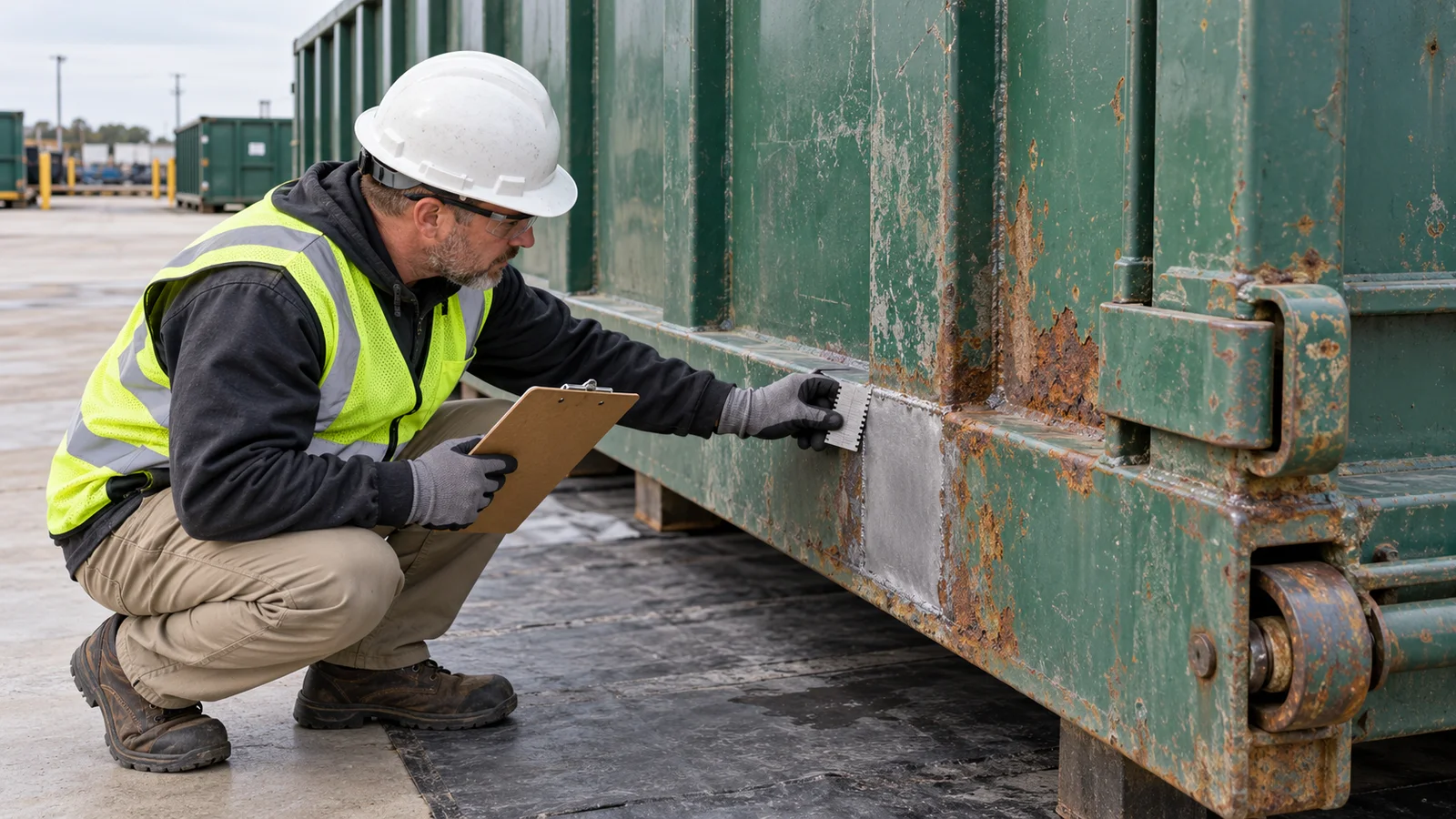
Select one representative container for a test area. Include a broad panel, rib, weld, lower rail, and a typical corrosion zone. The purpose is to align the owner, preparation contractor, repair provider, painter, coating supplier, and inspector on:
- contamination that must be removed before blasting;
- coating and rust that must be removed;
- sound coating that may remain, if the system permits it;
- feathered edges between retained coating and prepared steel;
- required cleanliness and surface profile;
- acceptable treatment of pits, welds, edges, and tight transitions;
- flash-rust limits for wet abrasive preparation;
- inspection method and approval authority;
- maximum time between preparation and primer.
AMPP's surface-preparation standards committee maintains standards covering dry and wet abrasive blast cleaning, waterjetting, abrasive media, nonvisible contaminants, and surface-profile evaluation. The project specification and coating manufacturer should identify the exact standard and profile required; “clean metal” is not a measurable finish.
Protect Thin Sheet and Functional Details
Container panels are not all the same thickness, and corrosion may have reduced the remaining steel. Excessive pressure, heat, dwell time, or an aggressive angle can distort sheet, deepen pits, or erase details. Start conservatively, evaluate the test area, and adjust media, pressure, stand-off distance, nozzle angle, and travel speed to achieve the specification without avoidable damage.
Mask or remove items according to the owner's plan. That list may include serial plates, barcodes, RFID tags, customer decals, reflective tape, warning labels, grease points, bearings, roller surfaces, door seals, latch interfaces, hydraulic or electrical connections, and precision pickup surfaces. Record identification before covering or removing it so the correct markings return to the correct asset.
Do not blast directly into bearings, joints, openings, wiring, cylinders, or connected machinery. A broad side panel may be efficient to clean, while hinges, weld toes, undercuts, ribs, and rail transitions require controlled angles or complementary hand and power-tool work.
Control Dust, Slurry, Rebound, and Debris
Wet abrasive blasting can suppress airborne dust, but it still produces mist, spent abrasive, coating fragments, rust, and runoff. Dry blasting produces dust and rebound that can travel well beyond the container. Neither method eliminates the need for a planned work zone.
Controls may include portable screens, ground liners, drain protection, equipment separation, designated hose paths, exclusion zones, sealed debris containers, and wind limits. Nearby vehicles, painted assets, building openings, air intakes, workers, and customers must be protected. OSHA identifies dust, toxic metals, high noise, and other worker hazards in abrasive blasting, so competent hazard assessment, engineering controls, respiratory protection, hearing protection, PPE, training, and hygiene belong in the job plan.
For a full mobilization checklist, review mobile blasting site planning. A productive container yard has defined paths for incoming dirty units, cleaning, inspection, repair, preparation, coating, cure, acceptance, and return to dispatch. Crossing those flows creates contamination and tracking errors.
Match Preparation to the Coating System
The coating supplier should define substrate cleanliness, profile range, soluble-contaminant limits where applicable, environmental conditions, primer, finish coats, dry-film thickness, edge treatment, recoat windows, and cure before service. The preparation contractor should not guess at these values after blasting begins.
Pay special attention to welds, edges, pits, lower rails, and door hardware. Stripe coating may be specified before full coats because those features are difficult to cover uniformly. Deep pits need inspection; filling them with paint does not replace missing steel. If a retained coating system is allowed, its adhesion and compatibility with the new materials should be confirmed.
Prepared steel should move promptly through cleaning, inspection, and primer. Do not prepare more units than the coating crew can accept inside the product's environmental and time limits. When wet preparation is used, agree in advance on drying and permissible flash rust.
Plan Fleet Downtime as a Production Line
Grouping containers can reduce repeated mobilization and make inspection more consistent, but only if the owner controls the flow. Establish a realistic daily quantity based on cleaning, repair, preparation, coating, weather, and cure—not simply the blasting rate.
Assign every asset a visible status: scheduled, emptied, cleaned, released, inspected, held for repair, test-approved, prepared, accepted, primed, finish-coated, curing, final-inspected, or returned to service. Keep a reserve fleet so customer routes do not pressure the team to skip cure time or return an incomplete unit.
Batch similar containers where possible. A run of comparable roll-off boxes with the same coating system is easier to control than a mixed group of food-waste dumpsters, compactors, specialty boxes, and heavily repaired scrap containers. Start with a pilot batch, record actual cycle time, and use those results to plan the remaining fleet.
Inspect and Document Every Container
The approved test area is the reference, but each unit still needs acceptance. Inspection may include visible cleanliness, profile, dust, nonvisible contaminants when specified, ambient conditions, time to primer, coating batch data, stripe-coat completion, dry-film thickness, cure, and final appearance.
The closeout record should tie information to the asset number:
- before, defect, prepared, repaired, and completed photographs;
- original coating-test or hazardous-material information;
- repair exceptions and owner decisions;
- preparation standard and profile readings;
- environmental readings and inspection acceptance;
- primer and finish products, batch numbers, and application dates;
- coating thickness and cure checks required by the specification;
- restored labels, reflectors, decals, and identification;
- date and person authorizing return to service.
Do not hide rejected or deferred units inside a fleet total. Containers held for contamination, structural damage, access, weather, or coating incompatibility should remain on an exception list with a clear next action.
Send a Bid-Ready Container Fleet Scope
A useful request for pricing includes:
- project ZIP code, yard access, and primary contact;
- total quantity by container type, size, and service;
- representative photos of every condition category;
- typical contents and documented emptying and cleaning process;
- known coating age, layers, and testing results;
- floor, rail, door, hinge, weld, and lifting-point condition;
- repair responsibility and planned sequence;
- required preparation standard and profile;
- coating products, colors, film thickness, and cure requirements;
- masking, decal, serial-plate, RFID, and reflector requirements;
- containment, runoff, cleanup, and waste responsibilities;
- daily release quantity, reserve-fleet plan, and deadline;
- inspection, documentation, and return-to-service authority.
Photos should include full sides, both ends, the floor from outside an open and secured door, the understructure where safely visible, and close views of typical rust and repairs. Never climb into a container just to take bid photos.
Frequently Asked Questions
Can a roll-off container be blasted while it is on a truck?
It should be staged separately for this process. Removing the truck keeps preparation, containment, inspection, and coating away from vehicle systems and prevents dispatch movement during the work.
Does the container need to be washed before blasting?
Yes. It should arrive empty and cleaned for its prior service. Abrasive preparation does not replace removal of waste, grease, biological residue, chemicals, or unknown contamination.
Should every dumpster be blasted to bare metal?
Not automatically. The required degree of removal depends on coating condition, adhesion, compatibility, corrosion, service, and the specified new system. Approve a representative test area first.
Can blasting repair thin floors or cracked welds?
No. Preparation can reveal defects, but it does not restore metal thickness or structural capacity. The owner or qualified repair provider must evaluate and repair those conditions.
Is one container enough for a mobile project?
It may be possible, but grouped projects usually use mobilization, containment, inspection, and coating coordination more efficiently. Send the full inventory and desired schedule so the contractor can review a practical batch size.
Request a Grouped Container Fleet Review
Manases EcoBlast provides mobile wet abrasive blasting and surface preparation from Great Bend and Austin for qualified commercial, municipal, and industrial projects across Kansas, Oklahoma, and Texas. Send the project ZIP code, container types and quantities, representative photos, typical service, cleaning status, coating requirements, and schedule to contact@manasesecoblast.com or call 512-592-1288.
For the fastest review, group photos by condition, identify any units connected to powered equipment, describe the repair plan, and state how many empty and cleaned containers can be released in each production batch.