
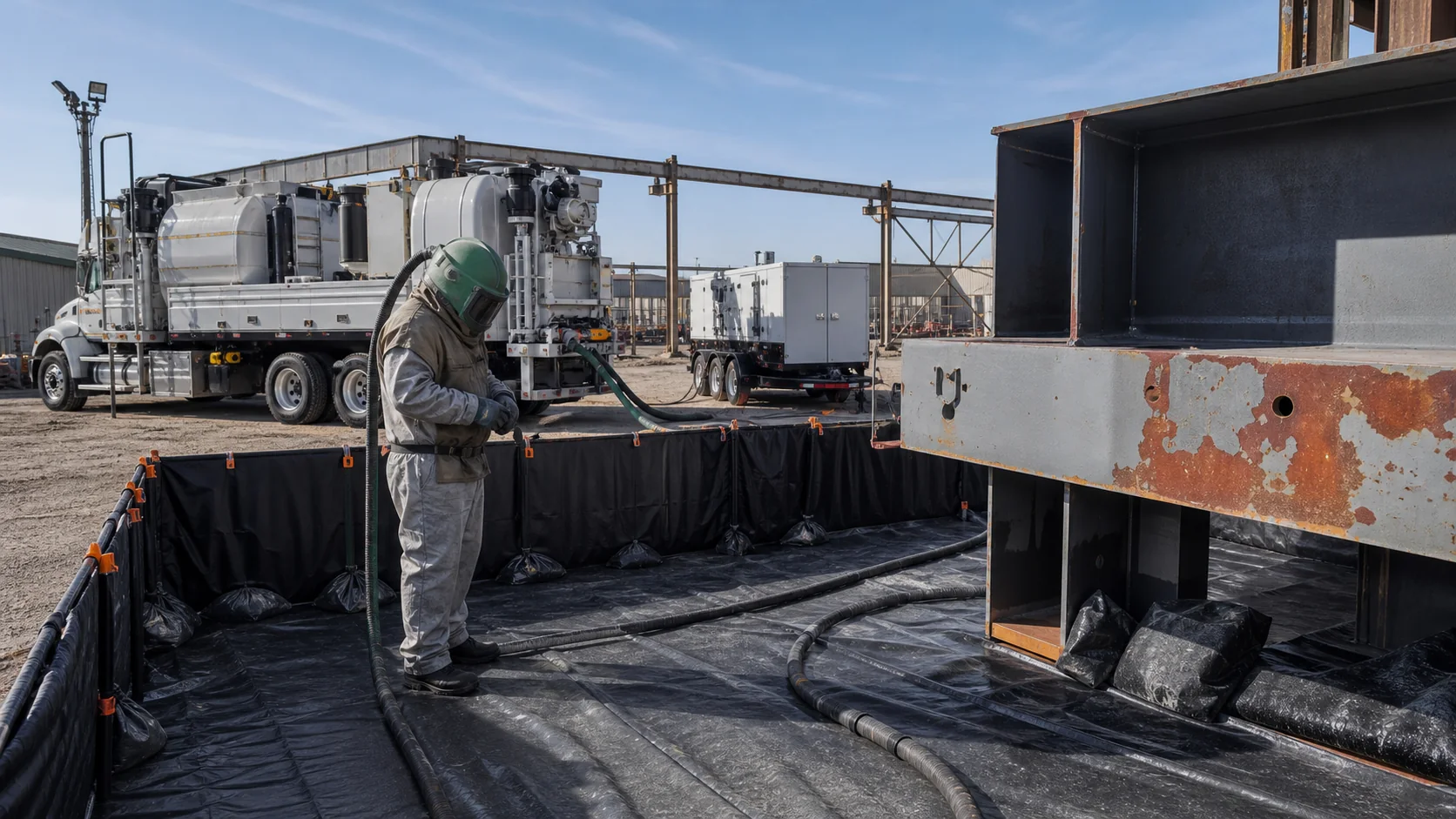
Mobile blasting brings the surface-preparation equipment to the asset. That can eliminate hauling, reduce handling, and keep large steel, concrete, fleet, and industrial components where they already sit. It does not eliminate the need for a planned work zone.
Before a crew mobilizes, the owner and contractor should know where the truck will stage, how hoses will reach the work, what must remain accessible, which surfaces need protection, how water and debris will be contained, and who accepts the area after cleanup. If those questions wait until the equipment arrives, an otherwise straightforward project can lose hours to moving vehicles, protecting drains, relocating materials, or waiting for another trade.
The best site plan does not need to be elaborate. It needs to reflect the actual coating, substrate, property, neighbors, operations, and handoff.
Treat the Work Zone as Part of the Scope
The blast area is larger than the square footage being prepared. It includes equipment staging, hose routes, worker access, exclusion boundaries, containment, material handling, inspection access, and cleanup.
Start with a marked site photo or simple plan showing:
- the surface or assets included in the project;
- the mobile unit and support-equipment staging area;
- the route from the equipment to the work face;
- entrances, fire lanes, loading areas, and required emergency access;
- nearby workers, tenants, vehicles, equipment, and public areas;
- floor drains, storm drains, soil, landscaping, and drainage paths;
- air intakes, open doors, sensitive machinery, and finished surfaces;
- the debris collection and temporary storage location.
This first layout often reveals whether the planned work area is realistic. A truck may fit through the gate but lack room to turn. A hose may reach the asset but cross a forklift lane. A containment screen may protect parked vehicles while redirecting mist toward an air intake. Those are easier problems to solve on a plan than during mobilization.
Confirm Access, Ground Conditions, and Staging
Mobile equipment needs a stable, accessible place to operate. Provide the project address, gate width, overhead-clearance concerns, surface conditions, and any weight or access restrictions before scheduling. Photographs of the entrance, route, and staging area are useful when the site has tight turns, soft ground, slopes, curbs, overhead utilities, or active traffic.
The staging area should support the work without blocking the facility. Confirm where the crew may park, unroll hoses, place containment materials, load waste, and refuel or service equipment if required. Identify operating hours, gate procedures, escorts, badges, orientations, and site-specific rules.
Hose routing deserves its own review. Blast and air hoses should not become an unplanned obstruction across doorways, pedestrian routes, vehicle lanes, ladders, or the next trade's work. Where a crossing cannot be avoided, the controlling contractor should determine how that crossing will be protected and managed.
Identify the Coating and Debris Before Choosing Controls
Containment should match what the process will remove. Rust scale, a known modern coating, heavy multilayer buildup, chemical residue, and an unknown old coating do not create the same planning questions.
Record the coating's known age, service history, prior repairs, and any available testing. The owner or controlling contractor may need representative sampling or a hazardous-material review before disturbance when the coating or contamination is unknown. Water in a wet abrasive system reduces airborne dust, but it does not make hazardous coating ingredients or process residue harmless.
The abrasive, removed coating, corrosion products, water, and existing contamination become part of the project debris. Their characteristics affect collection, handling, storage, transport, and disposal. Define who is responsible for characterization and final disposition rather than assuming cleanup ends when the visible grit is gone.
OSHA notes that blasting dust can contain respirable particles from both the abrasive and the surface coating, and that their composition must be considered when evaluating hazards. Its guidance also recommends isolation, barriers, restricted areas, and ventilation or collection controls as appropriate to the operation. Review OSHA's abrasive-blasting worker guidance and the requirements applicable to the project.
Design Containment Around the Site
Containment is not one product or one enclosure. The right arrangement depends on the preparation method, coating, substrate, wind, elevation, nearby property, drainage, public exposure, and applicable requirements.
Depending on the work, controls may include:
- ground covers or lined collection areas;
- portable screens or curtain walls;
- drain covers, berms, or controlled collection points;
- protection around adjacent equipment and finishes;
- partial or full enclosures;
- vacuum recovery or other collection equipment;
- restricted access and a clearly identified exclusion zone.
Containment must remain usable throughout the project. A cover that tears under equipment traffic, a screen that cannot handle the expected wind, or a berm located where workers repeatedly step over it will not perform as intended. Plan how controls will be inspected, maintained, adjusted, and removed without releasing the collected material.
Wet abrasive blasting can substantially reduce airborne dust compared with traditional dry blasting, but “dustless” does not mean debris-free. Mist, spent abrasive, coating fragments, rust, and water still need control. After the water evaporates, fine material can dry and become airborne again if cleanup is delayed or handled poorly.
Protect Drainage, Soil, and Adjacent Operations
Before work begins, walk the path that water would take if it escaped the immediate blast area. Identify trench drains, storm inlets, floor drains, ditches, slopes, unpaved ground, and low points. Do not assume a drain is connected to an approved collection system; the facility should identify where it leads and what site rules apply.
Nearby operations may create equally important constraints. Protect or isolate:
- HVAC and process-air intakes;
- open products, inventory, and packaging;
- electrical panels and sensitive instruments;
- bearings, seals, polished rods, threads, and process openings;
- finished vehicles, windows, signage, and adjacent coatings;
- occupied areas, customer routes, and neighboring property.
The owner should identify components that require removal, engineered masking, or exclusion from the scope. A loose cover is not automatically adequate protection from abrasive impact, moisture, or rebound.
Build Traffic and Access Control Into Production
Commercial sites rarely stop operating because one surface needs preparation. Forklifts, deliveries, employees, tenants, farm equipment, service trucks, and other trades may still need to move around the property.
Define who controls the work area and who can stop conflicting traffic. Establish boundaries, signs, spotters, alternate routes, and working hours as required by the site. If the project affects a loading dock, parking row, gate, or production aisle, agree on the outage window before equipment arrives.
Sequence can reduce disruption. A fleet yard may release one row of trailers at a time. A facility may prepare one elevation while another entrance remains open. An industrial project may divide structural steel into sections that can be prepared, inspected, repaired, and primed before the work zone moves.
The fastest nozzle production rate is not necessarily the fastest project. A controlled sequence often prevents rework and keeps the facility, inspector, repair crew, and coating team moving together.
Confirm Utilities and Site Support
Mobile equipment is built to bring much of the process to the project, but site needs still vary. Confirm water availability, permitted fill points, hose connections, electrical needs, lighting, restrooms, wash areas, and any restrictions on idling, noise, or operating hours.
Do not assume a visible hydrant, hose bib, outlet, or water tank is available for contractor use. The owner should identify approved connections and any backflow, metering, permit, or facility requirements. If the project will operate after dark or inside a structure, include lighting and visibility in the work-zone review.
Weather also affects support needs. Wind can change the containment plan. Rain can overwhelm collection areas. Heat and cold affect workers and equipment. Surface temperature, humidity, and condensation can shorten or eliminate the coating window even when blasting itself could continue.
Plan Cleanup Before Production Starts
Cleanup is easiest when the collection route is designed into the setup. Decide where material will accumulate, how it will be recovered, what equipment will be used, where containers will sit, how they will leave the work zone, and who approves the final condition.
The cleanup standard should be specific. “Leave it clean” may mean different things to a facility manager, paving contractor, coating inspector, and blasting crew. Define whether acceptance includes:
- recovery of visible abrasive and coating debris;
- removal of ground covers and temporary protection;
- cleaning of nearby ledges, equipment, and traffic areas;
- drain and soil inspection;
- removal or turnover of waste containers;
- photographs of the restored work area;
- confirmation that protected equipment and access routes are returned to service.
Avoid cleanup practices that simply redistribute fine material. OSHA's guidance emphasizes controlling accumulated dust and removing it without contaminating other work areas. The method should match the debris and applicable site procedures.
Connect the Site Plan to Inspection and Coating
Surface preparation is usually a handoff, not the final finish. The work zone must allow the owner, inspector, repair crew, and coater to reach the prepared surface without contaminating it or crossing active blasting operations.
Before mobilization, establish:
- the required surface-cleanliness standard and profile;
- who inspects and accepts the prepared surface;
- representative test-area requirements;
- repair hold points after coating or corrosion removal;
- how prepared surfaces will be kept dry and clean;
- who monitors environmental conditions;
- when primer or the next system will be applied;
- what happens if weather or another trade delays the handoff.
AMPP's Surface Preparation Committee maintains standards covering dry and wet abrasive blast cleaning, abrasive media, surface cleanliness, nonvisible contaminants, and profile evaluation. The project specification and coating manufacturer's requirements should identify the criteria that apply. Review AMPP's surface-preparation standards overview rather than relying on an informal phrase such as “blast it clean.”
Send a Mobilization-Ready Project Scope
A useful first request lets the blasting contractor review method fit, crew location, access, containment, and schedule before proposing the next step. Include:
- project ZIP code and site contact;
- wide photos of the property, asset, and access route;
- close-ups of representative coating failure, rust, concrete, or buildup;
- surface type, approximate dimensions, quantity, and elevation;
- known coating age, type, testing, and contamination history;
- desired removal level, finish goal, and intended next system;
- equipment or finishes that must be removed, protected, or excluded;
- gate dimensions, overhead restrictions, staging area, and ground conditions;
- active traffic, occupied areas, operating hours, and shutdown windows;
- drainage, soil, air-intake, neighbor, and containment concerns;
- utility availability and site-access requirements;
- inspection, repair, primer, cleanup, and disposal responsibilities;
- target dates and return-to-service requirements.
One marked-up site plan and a focused set of wide and close photographs are often more useful than dozens of unorganized images. The goal is not to design the entire project by email. It is to identify the real constraints early enough to plan a productive site visit, test area, or mobilization.
Frequently Asked Questions
Does wet abrasive blasting eliminate the need for containment?
No. Water can reduce airborne dust, but the process still produces mist, abrasive, removed coating, corrosion products, and water. Controls should match the material, surface, site, drainage, adjacent operations, and applicable requirements.
Who is responsible for preparing the work area?
Responsibilities should be assigned in the scope. The owner or controlling contractor commonly controls site access, operating status, traffic, utilities, hazardous-material information, and facility rules. The blasting contractor should define the equipment staging, process boundaries, and work-zone needs for its operation. Project-specific roles must be agreed before mobilization.
How much room does a mobile blasting crew need?
There is no useful universal dimension. Space depends on the equipment configuration, hose reach, asset geometry, containment, material handling, traffic, and emergency access. Send entrance, staging, and work-area photos with approximate dimensions for review.
Can blasting continue while other trades work nearby?
Only when the controlling contractor's plan keeps people outside the affected area and addresses dust or mist, noise, visibility, rebound, hoses, traffic, and simultaneous operations. In many cases, sequencing or temporary separation is more practical than overlapping the work.
Does the blasting crew dispose of all project debris?
Do not assume so. Collection, characterization, container supply, transport, disposal, and documentation should be assigned in the proposal or contract. Existing coating and site contamination can change those requirements.
Request a Mobile Surface-Preparation Review
Manases EcoBlast provides mobile wet abrasive blasting and surface preparation from Great Bend and Austin for qualified commercial and industrial projects across Kansas, Oklahoma, and Texas. Send site photos or plans, the project ZIP code, approximate size, surface, existing coating, access conditions, finish requirement, and timeline to contact@manasesecoblast.com or call 512-592-1288.
For the fastest review, include one wide photo of the work area, close-ups of the representative surface condition, the proposed equipment-staging area, and anything nearby that must remain accessible or protected.