
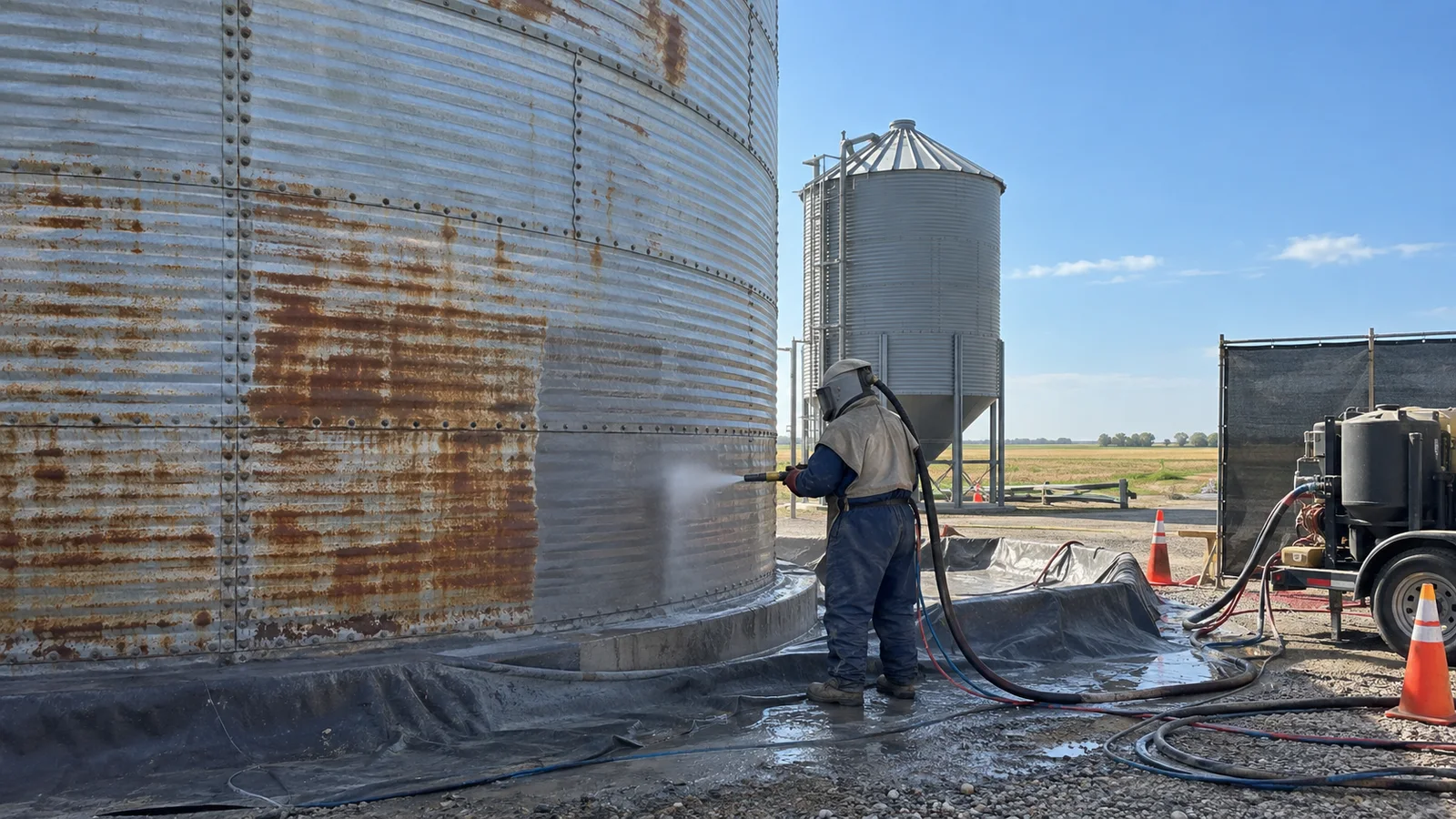
Grain bins, silos, elevator legs, hoppers, access platforms, and support steel spend years exposed to sun, wind, moisture, temperature swings, dust, fertilizer, and routine facility traffic. Rust streaks may begin around fasteners, seams, ladders, roof edges, discharge areas, and damaged coating. Once deterioration spreads, a new coat of paint cannot solve the problem by itself. The owner first needs to know what is failing, what metal is underneath, and what the replacement coating requires.
Mobile surface preparation can keep large agricultural structures in place while exterior steel is cleaned, evaluated, repaired, and prepared for recoating. The method still has to fit the substrate, existing coating, facility operations, access plan, weather, containment, and inspection standard.
This guide focuses on exterior surface preparation. Interior entry introduces a different set of engulfment, atmospheric, mechanical, and rescue hazards and should never be treated as an extension of ordinary exterior work.
Start With the Structure and the Maintenance Goal
“Grain bin” can describe a small corrugated farm bin, a large commercial storage bin, a hopper-bottom structure, or one part of a complex elevator facility. The same property may also include smooth-wall silos, structural towers, galleries, conveyors, dryer equipment, catwalks, and painted support steel. List the specific structures and elevations included before choosing a preparation method.
For each asset, record:
- diameter, height, panel or plate type, and roof configuration;
- carbon steel, galvanized steel, aluminum, or another known substrate;
- existing coating type, age, number of layers, and repair history;
- visible rust, peeling, chalking, blistering, impact damage, or water entry;
- fasteners, seams, stiffeners, welds, ladders, platforms, and penetrations;
- areas excluded from the work;
- the intended primer and topcoat system;
- the maintenance window and required return-to-service date.
The objective may be complete coating removal, selective preparation of failed areas, a uniform maintenance surface, or exposure of corroded steel for inspection and repair. Those outcomes require different production plans. Define the finish before discussing equipment or price.
Separate Exterior Work From Bin Entry
An exterior crew should not need to enter a grain storage structure simply because the outside requires preparation. Treat any proposed interior access as a separate, site-controlled scope.
At grain-handling facilities covered by its standard, OSHA identifies engulfment, moving equipment, hazardous atmospheres, grain dust, fire, explosion, and falls among the major hazards. The standard includes requirements for contractor coordination, lockout or tagout, training, permits, atmospheric testing, observers, and rescue provisions in applicable entry situations. OSHA also notes that the federal grain-handling standard does not apply to every on-farm storage operation, but that distinction does not make an unplanned entry safe. Review OSHA's grain-handling overview and determine which federal, state, facility, and employer requirements apply to the actual site.
Before exterior work begins, the owner or controlling contractor should confirm that the bin is in a safe operating state, identify any restricted areas, and establish who controls access. If preparation affects hatches, vents, aeration equipment, conveyors, augers, electrical systems, or other components, the facility should define the isolation and release procedure.
Coordinate Shutdowns, Grain Dust, and Ignition Control
Abrasive blasting uses high-pressure equipment and can disturb old coatings, corrosion products, deposited dust, and debris. Grain facilities may also contain combustible dust and active mechanical systems. The work plan must account for both the blasting process and the facility's operating hazards.
Confirm whether grain receiving, conveying, drying, loading, aeration, or housekeeping will continue nearby. Identify dust collectors, vents, fans, electrical equipment, bearings, fuel systems, and other sensitive or ignition-related components. Establish the exclusion zone, traffic controls, equipment shutdowns, and permit requirements before hoses are routed through the site.
The facility remains responsible for its operating condition and process controls. The surface-preparation contractor should receive a clearly released exterior work area and enough information to plan the equipment, controls, and sequence safely. Do not assume that outdoor work is automatically separated from grain-handling hazards.
Inspect the Coating Before Selecting a Method
The visible topcoat may hide several maintenance generations. A bin can have sound coating on broad panels, active rust at fasteners, heavy buildup near the base, and bare galvanized metal where previous preparation removed the original surface condition. One aggressive process across every area can remove material that did not need removal or create a profile the specified coating cannot accept.
Begin with representative inspection and testing. The owner may need to determine:
- whether older coating contains lead, chromium, or another regulated constituent;
- whether the surface is painted carbon steel, galvanized steel, or mixed material;
- coating thickness and adhesion in sound and failed areas;
- the presence of oil, fertilizer residue, salts, grain dust, biological growth, or other contamination;
- the degree of corrosion, pitting, perforation, or fastener deterioration;
- which existing coating may remain under the maintenance system.
OSHA's abrasive-blasting guidance explains that hazards can come from both the abrasive and the coating or substrate being disturbed. Water can reduce airborne dust in a wet abrasive process, but it does not make hazardous coating ingredients harmless. Review OSHA's abrasive-blasting fact sheet and build controls around the materials actually present.
Clean First, Then Evaluate the Steel
Loose grain dust, soil, grease, biological growth, fertilizer, bird residue, and other contamination can hide coating failure and interfere with both blasting and recoating. Abrasive blasting should not be used as a substitute for appropriate cleaning or decontamination.
The owner and coating supplier should identify the cleaning steps compatible with the structure and proposed coating. Pay particular attention to the bin base, anchor area, discharge equipment, roof runoff paths, lap seams, and surfaces below vents or penetrations. Cleaning can reveal additional corrosion, failed sealant, damaged fasteners, or water-entry points that need repair before final preparation.
Document the cleaned condition with wide photographs and close-ups. If the scope changes after cleaning, resolve the repair and coating decisions before the crew prepares large areas.
Use a Representative Exterior Test Area
A test area connects the written coating requirement to the actual bin. Choose a location that includes representative corrugations, seams, fasteners, coating failure, and rust—not only an easy flat or lightly weathered section near ground level.
The test should help the team agree on:
- the coating and corrosion that must be removed;
- whether sound existing coating can remain;
- the acceptable appearance at seams, fasteners, and pits;
- the required cleanliness and surface profile;
- treatment of galvanized or mixed-metal areas;
- flash-rust limits when wet preparation is used;
- the inspection tools, records, and person responsible for acceptance;
- primer compatibility and maximum time before coating.
AMPP's surface-preparation committee maintains standards for dry and wet abrasive blast cleaning, coating and contaminant removal, abrasive media, nonvisible contaminants, and surface-profile evaluation. The project should name the standard that applies rather than relying on “blast clean” as the acceptance criterion. Review AMPP's surface-preparation standards overview with the coating specification and product data.
Plan Access Around Corrugated Geometry and Elevation
Ground-level panels are only part of the structure. Roof edges, stiffeners, ladders, platforms, supports, piping, vents, and elevated seams can determine whether the full exterior is practical to prepare and coat.
Define the access system separately from the blasting method. Depending on the structure and site, qualified contractors may evaluate lifts, scaffolding, suspended access, or another engineered approach. The owner should provide foundation and ground-condition information, overhead-clearance concerns, buried utilities, traffic restrictions, and available setup area.
Do not improvise elevated work from fixed bin ladders or unapproved surfaces. The access plan must address fall protection, falling objects, wind limits, emergency procedures, hose management, and how inspection and coating crews will reach the same prepared areas. If the next trade cannot safely prime the surface, preparing it faster does not help the project.
Design Containment for Wind, Water, and Facility Operations
Exterior bin work can spread mist, spent abrasive, rust, and coating fragments across a large yard if the work zone is not planned. Corrugated surfaces and curved walls also redirect rebound and runoff in ways that may differ from a flat steel panel.
Depending on the coating, process, elevation, and site, controls may include ground covers, portable screens, partial enclosures, drain protection, controlled collection points, restricted areas, and staged debris containers. Identify nearby grain, vehicles, buildings, air intakes, electrical equipment, open doors, soil, storm drains, and neighboring property.
Wind is a production and containment variable, not just a comfort issue. Establish conditions that require work to pause or the containment to change. Rain can overwhelm collection areas, while heat, cold, humidity, condensation, and steel temperature can affect the coating window. In Kansas, Oklahoma, and Texas, the daily plan may need to move between elevations or stop when weather no longer supports controlled preparation and timely primer.
For a broader setup checklist, review mobile blasting site planning.
Add Repair and Inspection Hold Points
Surface preparation exposes condition; it does not repair the structure. Rust removal may reveal perforation, section loss, loose fasteners, damaged seams, cracked welds, or deteriorated supports. Those findings belong with the owner, engineer, bin manufacturer, or other qualified professional responsible for structural decisions.
Create an inspection hold point after initial removal and before final preparation. Mark repair areas, photograph representative conditions, and assign who decides whether panels, fasteners, supports, or sealants are repaired or replaced. Welding, grinding, drilling, and panel replacement performed after final acceptance can contaminate or damage surrounding prepared steel.
Once repairs are complete, the crew can finish the agreed preparation and present the area for coating inspection. Keep the acceptance record tied to a clearly identified elevation or work section.
Match Production to Primer and Coating Capacity
Prepared steel is temporary. Moisture, condensation, dust, handling, facility operations, and weather can quickly make an accepted surface unsuitable for primer. Wet abrasive preparation also requires an agreed drying and flash-rust plan.
Before production starts, confirm:
- who supplies and applies primer and topcoat;
- the coating manufacturer's temperature, humidity, surface-temperature, and dew-point limits;
- acceptable profile and cleanliness;
- whether an inhibitor is proposed and compatible with the coating;
- how inspection results are recorded;
- the maximum interval between preparation and primer;
- what happens when weather or repairs interrupt the sequence.
Divide large bins or multiple structures into manageable sections. A completed section should move through preparation, inspection, repair, final acceptance, and primer before the crew exposes more steel than the coating team can protect. The most productive plan is the one that keeps the entire maintenance sequence moving.
Send a Bid-Ready Grain-Bin Scope
A useful first request helps a mobile contractor determine whether the project fits and what must be clarified during a site visit or test area. Include:
- project address or ZIP code and facility contact;
- structure type, quantity, diameter, height, and representative photos;
- wide views of access, foundations, adjacent equipment, and traffic;
- close-ups of coating failure, seams, fasteners, rust, and damaged areas;
- substrate and coating information, including known testing;
- exterior areas included, excluded, or difficult to reach;
- operating status, shutdown windows, and facility permit procedures;
- access-system responsibility and ground conditions;
- required surface standard, profile, and intended coating system;
- containment, drainage, cleanup, and disposal expectations;
- inspection, repair, primer, and topcoat responsibilities;
- schedule, weather constraints, and return-to-service date.
For sites with several structures, add a simple asset list and label each bin or silo in the photographs. A clear list prevents the estimator, access contractor, inspector, and coating crew from working from different assumptions.
Frequently Asked Questions
Can a grain bin be blasted while it remains in service?
That requires a site-specific decision by the owner or controlling contractor. Grain movement, dust, aeration, mechanical equipment, vents, access, contamination risk, and facility procedures can all affect whether exterior work is appropriate. The contractor should receive a clearly released work area rather than assume that an exterior surface is independent of operations.
Is this guide also for interior silo blasting?
No. Interior work may involve entry permits, lockout or tagout, atmospheric testing, engulfment hazards, observers, rescue planning, ventilation, and additional coating or food-contact requirements. It should be scoped and reviewed separately by qualified parties.
Does every grain bin need complete coating removal?
Not necessarily. The answer depends on coating adhesion, corrosion, substrate, repair needs, and the maintenance coating system. Representative testing and a coating specification should determine whether sound coating can remain and how transitions are prepared.
Can wet blasting be used on galvanized grain-bin panels?
Possibly, but the process must match the galvanized substrate and coating system. Media, pressure, angle, exposure, and profile requirements should be established with a representative test area. An overly aggressive process can damage a surface that only required controlled preparation.
How soon should primer be applied?
Within the interval allowed by the coating system and before rust, condensation, dust, or other contamination makes the surface unacceptable. The practical window depends on the metal, preparation method, weather, inspection timing, and product data.
Request a Grain-Bin or Silo Project Review
Manases EcoBlast provides mobile wet abrasive blasting and surface preparation from Great Bend and Austin for qualified agricultural, commercial, and industrial projects across Kansas, Oklahoma, and Texas. Send structure photos, the project ZIP code, approximate diameter and height, coating condition, access information, desired finish, and timeline to contact@manasesecoblast.com or call 512-592-1288.
For the fastest review, include one wide photograph of each structure, close-ups of representative coating failure and corrosion, the equipment-staging area, and the primer or coating requirement the prepared surface needs to meet.