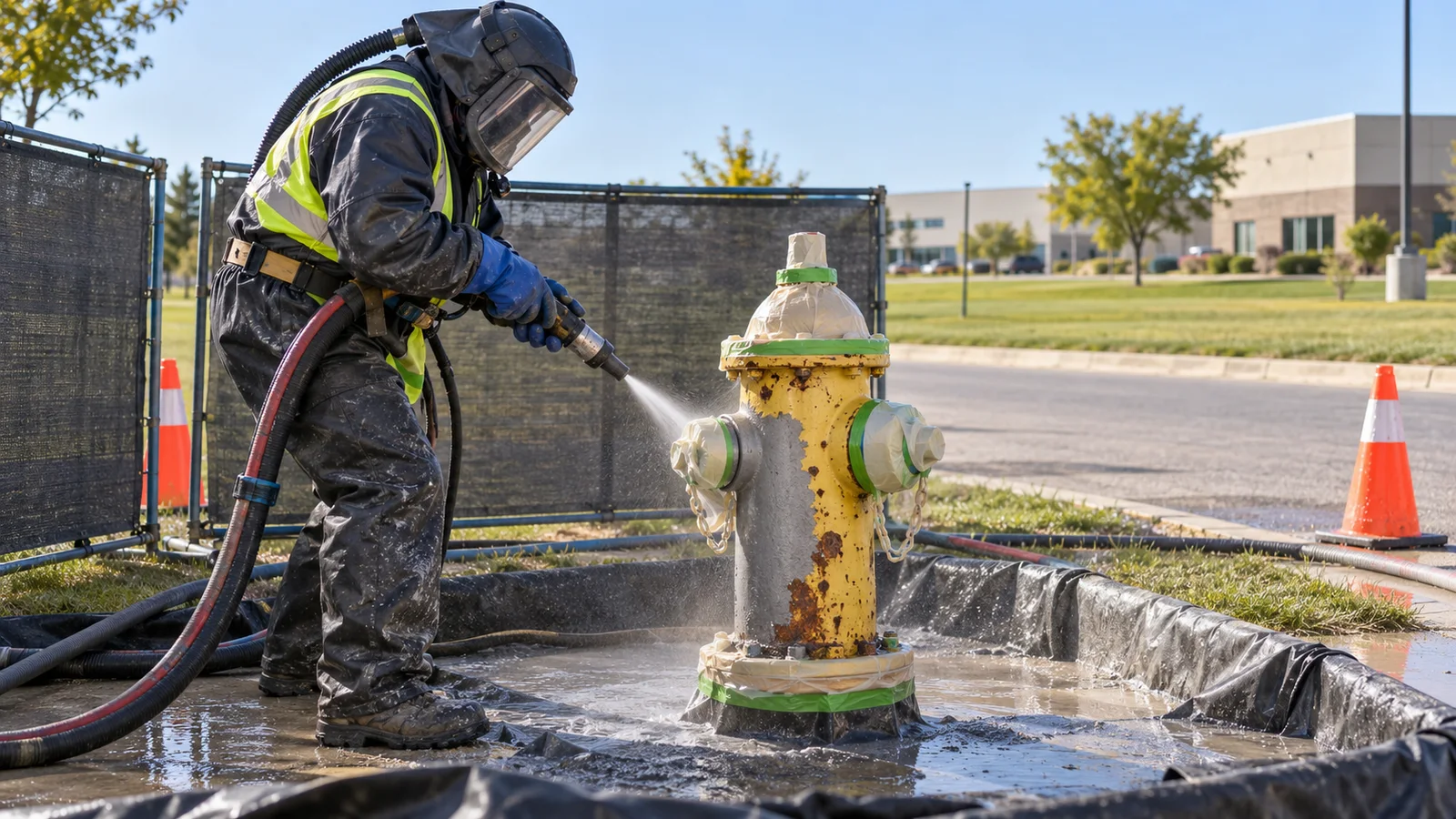
A fire hydrant may occupy only a few square feet, but it is not ordinary street furniture. Its coating protects exposed metal, its color may communicate information defined by the water utility or fire authority, and its operating parts must remain usable after maintenance. A repainting project therefore needs more than a quick scrape and a new topcoat.
Effective fire hydrant surface preparation starts with utility authorization, inspection, coating identification, masking, containment, and a defined coating system. For municipalities and water districts, it also requires a route that moves crews efficiently without losing track of which hydrants are isolated, prepared, inspected, coated, cured, and returned to service.
This guide focuses on exterior coating preparation. Testing, exercising, repairing, operating, isolating, or returning a hydrant to service belongs to authorized utility or fire-protection personnel under the owner’s procedures.
Treat Each Hydrant as an Operating Asset
Before discussing paint removal, identify who owns the hydrant and who has authority over it. Public utilities, private water systems, industrial plants, campuses, airports, commercial developments, and fire-protection systems may use different hydrant models, inspection programs, color requirements, and shutdown procedures.
Build an asset list that records:
- hydrant ID, address, GPS point, or map location;
- owner, utility contact, and fire-authority contact where applicable;
- manufacturer, model, barrel type, and approximate age if known;
- in-service, isolated, out-of-service, or inspection status;
- coating color, layers, condition, and known maintenance history;
- visible leakage, impact damage, loose components, or missing caps and chains;
- access, traffic, landscaping, curb, sidewalk, and drainage conditions;
- preparation, primer, finish-coat, and color requirements;
- inspection and return-to-service responsibility.
Do not let a surface-preparation crew operate, isolate, or disassemble a hydrant unless that work is explicitly assigned to trained and authorized personnel. The owner should deliver a clearly released asset and define which components may be touched.
Mueller’s hydrant maintenance guidance illustrates why coating work belongs inside a broader inspection program: paint condition is one item alongside leaks, caps, chains, threads, valves, operation, records, and follow-up repairs.
Group the Work Into a Practical Route
One isolated hydrant can carry a high mobilization cost. A planned group lets the owner spread setup, equipment, traffic control, inspection, and documentation across more assets. The best unit is not always the entire system; it may be a neighborhood, pressure zone, industrial site, campus sector, or maintenance district that can be completed and closed out together.
Before mobilization, divide the list into workable daily groups. Consider travel between assets, parking, hose setup, pedestrian routes, school or business hours, lawn irrigation, street sweeping, weather, and the coating crew’s capacity. Confirm how many hydrants can be safely released at once and whether the authority requires nearby coverage to remain available.
Assign a status to every hydrant: pending inspection, released, cleaned, masked, test area approved, prepared, repaired, primed, finish-coated, curing, accepted, or returned to service. A simple shared log prevents a fast-moving route from leaving an unfinished or incorrectly marked asset behind.
Inspect Before Disturbing the Coating
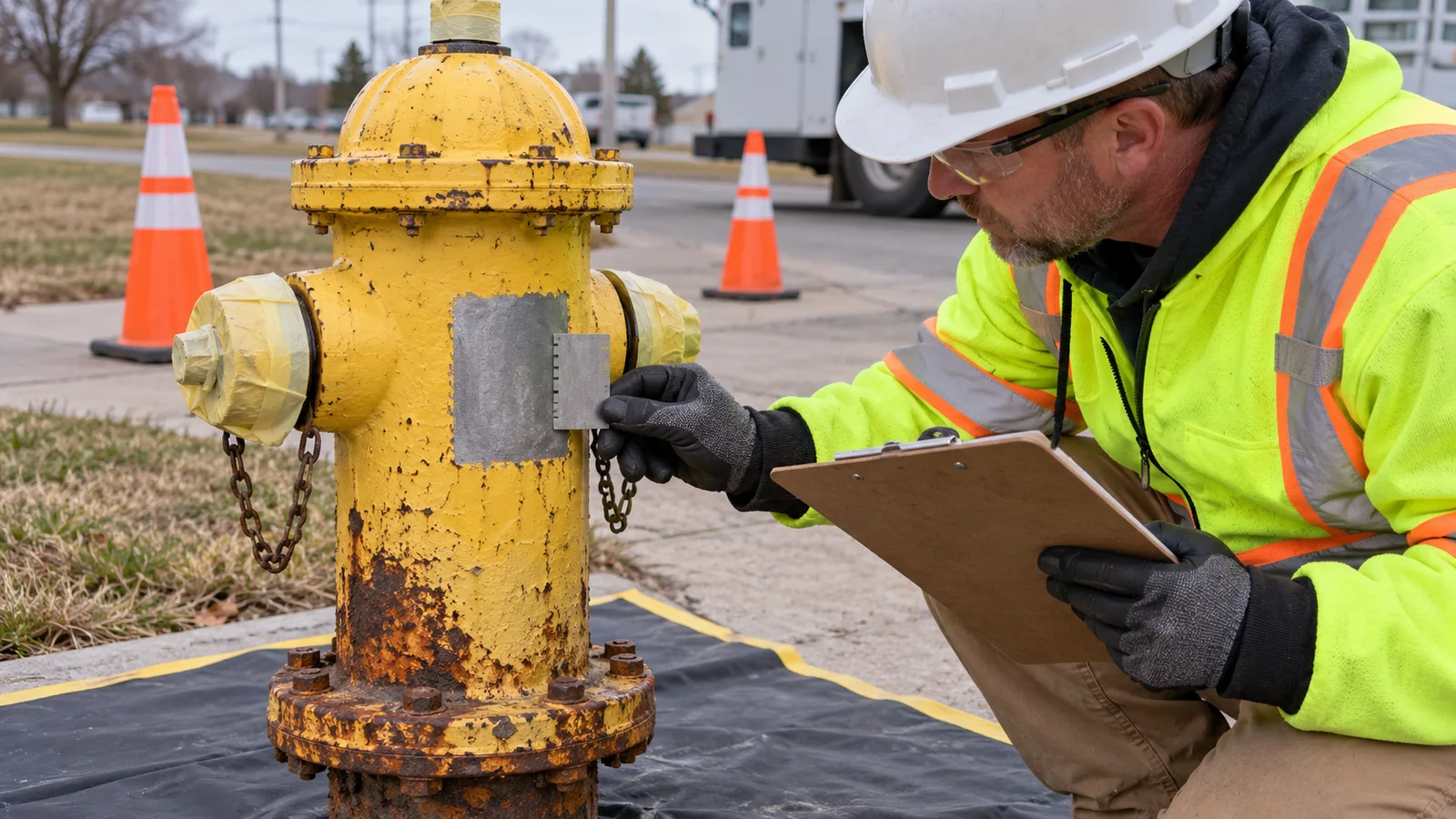
Photograph the complete hydrant and close details before preparation. Look for chalking, peeling, blistering, rust staining, impact damage, buried lower barrels, vegetation, standing water, concrete splash, and previous spot repairs. Pay special attention to flange joints, bonnet edges, nozzle bosses, bolts, chains, cap interfaces, and the ground line.
Separate coating condition from mechanical condition. Surface preparation may reveal damaged castings, deep corrosion, leaking joints, deformed traffic flanges, loose fasteners, or components that need utility repair. Blasting does not determine whether a hydrant is functional or acceptable for fire protection.
Create a hold point for defects found during cleaning or removal. The owner should decide whether the hydrant proceeds, receives repair, or is removed from the coating route. Do not cover an active leak or questionable component simply to keep the painting schedule moving.
Identify Legacy Coatings and Site Contamination
Hydrants may have accumulated many maintenance layers. Color alone cannot identify coating chemistry or confirm that every layer is compatible with the proposed system. Older coatings may contain lead, chromium, or other regulated constituents, and roadside surfaces can carry oil, salts, soil, fertilizer, animal waste, and other contamination.
Representative coating testing should occur before disturbance when age or records create uncertainty. Results can affect worker protection, containment, hygiene, waste characterization, transport, and disposal. OSHA’s abrasive-blasting fact sheet explains that hazards may come from both the abrasive and the coating or substrate being disturbed.
Wet abrasive blasting can reduce airborne dust compared with dry blasting, but it does not neutralize hazardous coating debris. The water, abrasive, rust, and paint fragments still require appropriate collection and management. For lead-related work, OSHA’s lead-in-construction guidance describes engineering controls and less-dusty removal methods that employers may evaluate as part of a compliant plan.
Clean First and Approve a Test Hydrant
Remove dirt, grease, biological growth, loose soil, salts, and other compatible contamination before abrasive preparation. Blasting over residue can spread contamination and make it harder to evaluate the coating. Protect surrounding landscaping and confirm where wash water may be collected.
Use one representative hydrant as a test asset before launching the full route. It should include typical coating buildup, rust, casting texture, bolts, and lower-barrel conditions. The test should align the utility, preparation contractor, coating supplier, inspector, and painter on:
- coating and corrosion that must be removed;
- sound existing coating that may remain, if allowed;
- required cleanliness and surface profile;
- feathered edges around retained coating;
- acceptable appearance on rough castings and pits;
- masking and component-protection details;
- flash-rust limits when wet preparation is used;
- primer compatibility and maximum time before coating;
- inspection records and approval authority.
The accepted test becomes a visual and measurable reference for the route. Photograph it from several angles and record the media, settings, condition, and coating requirements that produced the result.
Mask the Parts That Must Still Work
Hydrants combine protective coating surfaces with operating and connection points. Overspray, abrasive, water, or coating buildup in the wrong place can interfere with use or maintenance. Masking should follow the owner’s specification and the manufacturer’s current instructions for the exact model.
The review may include:
- nozzle cap and body threads;
- cap vent holes and gasket interfaces;
- operating nuts, valve stems, and lubrication points;
- cap chains and free-moving rings;
- drain or weep features where present;
- breakaway or traffic-flange interfaces;
- identification plates, tags, reflective markers, and barcodes;
- adjacent concrete, pavement, signs, landscaping, and utility hardware.
Do not assume every visible metal part should receive the same coating thickness. Heavy buildup across moving interfaces, threads, vents, or breakaway details can create problems. Mueller’s white paper on proper fire-hydrant painting emphasizes both maintenance protection and color classification, reinforcing the need to follow owner and manufacturer requirements rather than an improvised paint scheme.
Control Abrasive, Water, and Public Access
Hydrants often sit beside roads, sidewalks, schools, businesses, homes, parked vehicles, storm drains, and landscaping. Even a small object can create a wide work zone once screens, hoses, ground protection, equipment, and traffic control are added.
Depending on the coating and site, controls may include cones and barricades, portable screens, ground covers, drain protection, temporary pedestrian routing, vehicle separation, and sealed debris containers. Wet preparation produces mist and slurry; dry preparation can spread dust and rebound. Neither method is automatically suitable for an uncontrolled public area.
Plan hose crossings, equipment parking, noise, emergency access, and visibility around intersections. Maintain the clear space required by the owner and fire authority. Establish wind and rain limits, and stop work if containment cannot protect people, vehicles, neighboring property, or drainage.
For a broader setup checklist, review mobile blasting site planning.
Match the Method to Cast Iron and Existing Coating
Hydrant bodies often have textured cast surfaces, intricate contours, lettering, flanges, bosses, bolts, and tight transitions. Those details affect nozzle angle, dwell time, media selection, and handwork. A setting that cleans a broad barrel section may be too aggressive near sealing surfaces or ineffective in a deep casting recess.
Wet abrasive blasting can combine coating removal and surface profiling where the specification permits and the site can manage water. Power tools, hand tools, alternative media, or a combined approach may fit localized work or sensitive details. The least aggressive method that achieves the required finish should be established through the test hydrant.
The coating manufacturer’s requirements should define the acceptable substrate condition, profile, cleaning, environmental limits, and primer. A bright-looking hydrant is not proof that invisible contamination or profile requirements have been met.
Confirm Primer, Finish Color, and Identification Rules
Do not select colors from memory or copy a neighboring jurisdiction. The hydrant owner and fire authority should provide the coating system, body color, bonnet or cap color, identification markings, and any color-coding rules. Different systems may use color for ownership, service status, water-main information, or available flow classification.
Confirm the exact product names, approved colors, film thickness, application method, cure requirements, and treatment of previously coated areas. Determine whether the painter must stripe-coat bolts, edges, and complex details before the full coat. If a hydrant uses reflective bands, tags, decals, or digital asset labels, specify when they are restored.
Surface preparation and painting should move as one sequence. Prepared iron can rust quickly when exposed to moisture, and wet preparation requires an agreed flash-rust plan. Do not prepare more hydrants than the coating crew can inspect, prime, and protect within the product and weather limits.
Inspect, Document, and Return Each Hydrant to the Owner
Use the asset ID throughout preparation and coating. The completion record may include before and after photographs, coating-test results, preparation acceptance, ambient conditions, primer and finish products, batch information, film-thickness checks, repair notes, and completion dates.
After the coating has cured, authorized utility personnel should remove or verify masking as assigned, inspect operating and connection points, confirm identification, perform required maintenance or operational checks, and formally return the hydrant to service. The surface-preparation contractor should not make that determination independently.
Close out exceptions instead of hiding them in a route total. List hydrants that were inaccessible, leaking, damaged, not released, unable to meet the test standard, or held for repair. Accurate exceptions make the next maintenance cycle easier to plan.
Send a Bid-Ready Hydrant Project Scope
A useful request should include:
- owner, utility, fire-authority, and project contacts;
- project ZIP codes, map, hydrant IDs, and total quantity;
- representative photos and coating-condition categories;
- known manufacturers, models, and maintenance records;
- coating age and hazardous-material test results;
- isolation, release, operating, and return-to-service responsibilities;
- required preparation standard and approved test process;
- masking details and protected components;
- primer, finish-coat, color, marking, and cure requirements;
- traffic, pedestrian, drainage, landscaping, and property controls;
- containment, cleanup, waste, and documentation expectations;
- daily route limits, schedule, and inspection availability.
If the inventory is large, categorize hydrants by condition and location rather than sending only a total count. A route of lightly chalked hydrants is different from a route with heavy multilayer failure, ground-line corrosion, and missing parts.
Frequently Asked Questions
Can a contractor repaint a hydrant without utility approval?
No. The owner or responsible authority should approve the work, release each hydrant, define the coating and color system, control operational status, and determine when it returns to service.
Should every hydrant be blasted to bare metal?
Not automatically. The required preparation depends on coating adhesion, compatibility, corrosion, casting condition, and the approved new system. A representative test hydrant should establish the finish.
Can nozzle caps and operating nuts be painted?
Only as directed by the owner, manufacturer, and coating specification. Threads, gasket surfaces, vents, moving parts, and other functional interfaces may require masking or limited coating buildup.
Is wet abrasive blasting dust-free?
No. It can reduce airborne dust compared with dry blasting, but it still generates mist, coating debris, abrasive, rust, and runoff that must be controlled and collected.
Is one hydrant enough for a mobile project?
It may be technically possible, but grouped routes usually make mobilization, traffic control, inspection, coating, and documentation more efficient. Send the complete inventory so the contractor can evaluate a practical project size.
Request a Grouped Fire-Hydrant Project Review
Manases EcoBlast provides mobile wet abrasive blasting and surface preparation from Great Bend and Austin for qualified municipal, commercial, and industrial projects across Kansas, Oklahoma, and Texas. Send the project ZIP codes, hydrant count, representative photos, coating condition, approved finish requirement, and schedule to contact@manasesecoblast.com or call 512-592-1288.
For the fastest review, include a map or asset list, one wide photo of each condition category, close-ups of coating failure and lower-barrel corrosion, the owner’s masking and color requirements, and the number of hydrants available in each daily work zone.