
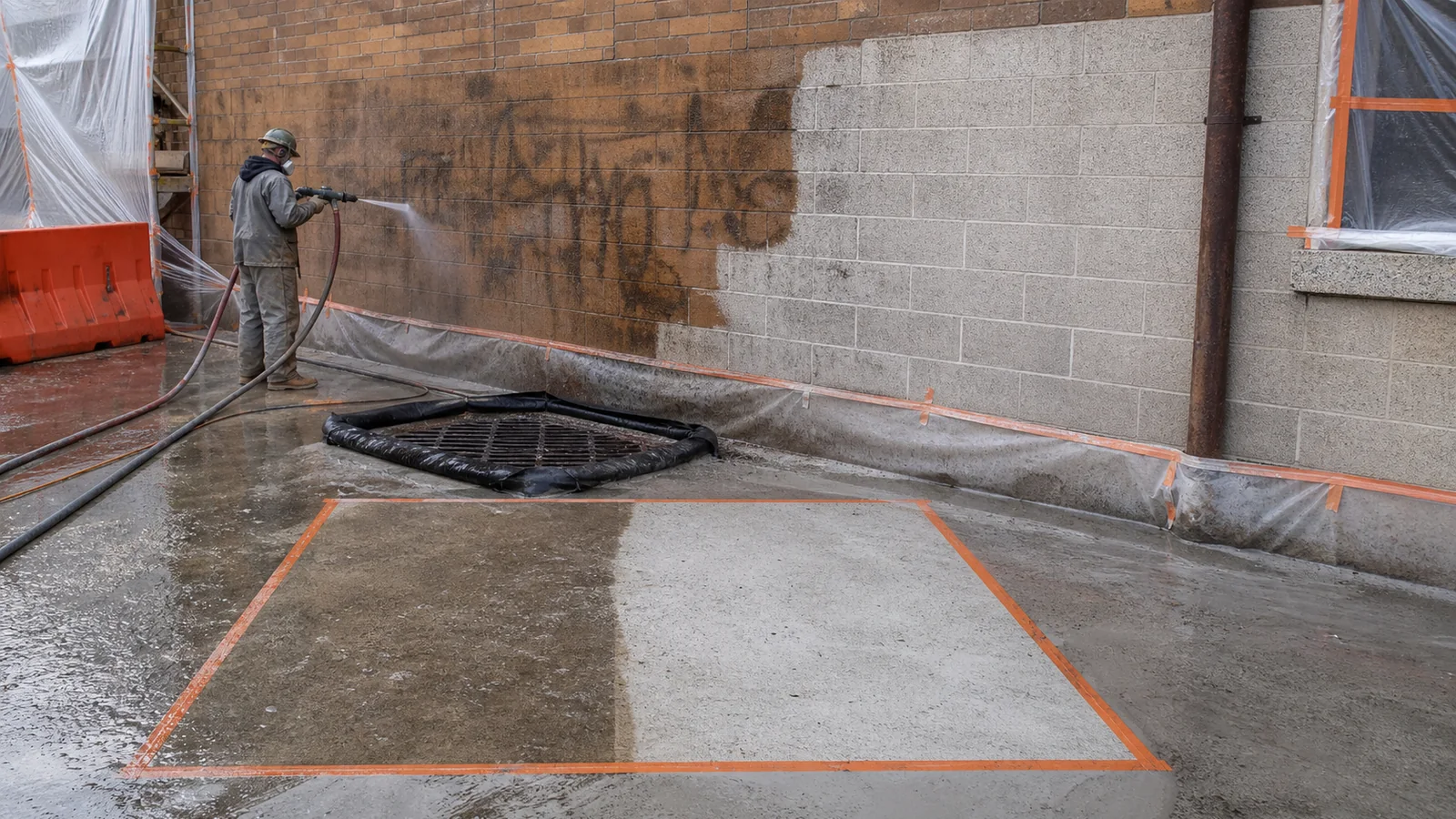
Epoxy, urethane, and traffic-bearing systems rely on the concrete beneath them. If laitance, weak paste, oil, curing compound, sealer, or failed coating remains, a new system may bond to material that is already ready to release. Preparation should therefore be designed around the slab’s condition and the coating manufacturer’s written requirements.
Manases EcoBlast provides mobile wet abrasive blasting and surface preparation for commercial teams in Kansas, Oklahoma, and Texas, operating from Great Bend and Austin. The goal is a defined handoff to the coating contractor—not a generic promise that a floor or deck has been “cleaned.”
Diagnose the slab before selecting a method
Concrete varies across one project. Placement and finishing practices, age, repairs, traffic, weather exposure, and chemical use can create different conditions only feet apart. Walk the entire scope and map polished traffic lanes, spalls, cracks, soft areas, previous patches, coating transitions, drains, joints, and visible contamination.
Ask for the slab and coating history. Was a curing compound or densifier used? Is there an existing sealer? Have forklifts leaked hydraulic fluid? Has the area handled food oils, fuels, deicing salts, or process chemicals? Was a prior coating removed or simply overcoated? Records may be incomplete, but the questions guide testing and test-area selection.
Preparation does not correct moving cracks, active leaks, vapor drive, unsound concrete, or poor drainage. Those conditions should be evaluated by the responsible designer, repair contractor, or coating manufacturer before a new system is installed.
Let the coating system set the acceptance criteria
The product data sheet and project specification should govern the required surface condition. The coating manufacturer or designer may identify a concrete surface profile range, minimum concrete strength, moisture limits, repair materials, cleaning steps, environmental conditions, and recoat timing. Requirements for a thin-film epoxy can differ sharply from those for a broadcast system, membrane, or vehicular traffic deck.
Before mobilization, document:
- areas included and excluded, with measured quantities;
- existing materials to remove and sound materials allowed to remain;
- target profile or approved visual reference;
- treatment of edges, joints, drains, penetrations, curbs, and vertical surfaces;
- required moisture, adhesion, or contaminant testing and who performs it;
- repair responsibilities and the inspection authority;
- acceptable condition at handoff, including dryness and cleanliness.
Abrasive preparation can expose existing defects; it does not diagnose their cause or make coating-design decisions. A clear division of responsibility keeps the preparation crew from guessing at system requirements in the field.
Use representative test areas
A test area is most useful when it represents the difficult conditions, not merely an easy corner. Consider separate samples in a traffic lane, near contamination, on existing coating, and at a repair transition. Mark and photograph each location, note the process used, and have the coating decision-maker inspect it.
The test should answer practical questions. Does the existing coating release cleanly or pull weak concrete with it? Is the resulting profile appropriate? Does staining remain after preparation? Are aggregate exposure and surface variation acceptable? Can edges and vertical returns be treated consistently? How much water, abrasive, containment, and cleanup are needed?
If adhesion testing is part of the project, the specification should identify the test method, timing, quantity, locations, and acceptance value. A successful small test does not prove that every part of a variable slab will behave identically, but it provides a shared benchmark and improves the production plan.
Separate removal, repair, and final preparation
A durable workflow often requires more than one pass through the area. Initial preparation may remove failed coating and weak surface material so cracks, spalls, delamination, and previous repairs become visible. The repair contractor then addresses defects with materials compatible with the coating system. A final preparation or cleaning step may be needed at repair edges and in areas contaminated during other work.
Joints deserve explicit treatment. Do not fill, bridge, or blast through them by assumption. The designer or coating manufacturer should state which joints remain active, which receive sealant, and how termination details are built. Similarly, drains and transitions need details that preserve function and avoid leaving fragile coating edges.
Sequence work so demolition dust, overhead work, vehicle traffic, and repair grinding do not contaminate an accepted slab. If areas must reopen between trades, define temporary protection and who will restore the surface before coating.
Control water, residue, and adjacent operations
Wet abrasive blasting can reduce airborne dust compared with dry methods, but it is not dust-free. It also introduces water that must be compatible with the site and coating schedule. Plan for floor slope, low points, drains, occupied spaces below, electrical equipment, finished walls, stored goods, and nearby production.
The work plan should identify drain protection, containment boundaries, runoff collection, spent abrasive recovery, ventilation needs, and the route for removing residue. Existing coating or contamination may affect testing, handling, and disposal requirements. Unknown materials should be investigated before disturbance.
In occupied facilities, coordinate noise, access, pedestrian detours, forklifts, loading docks, and air intakes. Mobile work still requires a controlled zone. Barricades, signage, suitable PPE, and housekeeping remain necessary even when dust suppression is used.
Protect the coating handoff window
Prepared concrete should be inspected while the area is accessible and before another trade enters. Use the accepted test area as a comparison and record exceptions. The coating crew should verify that the surface meets its specification, including required profile, cleanliness, soundness, moisture condition, and environmental limits.
Weather and interior climate can alter timing. Rain, wash water, condensation, or high slab moisture can delay coating. Surface dryness alone does not establish whether a slab meets a product’s moisture limits. Required testing should be completed with the specified method by the responsible party.
Plan production in sections the coating crew can accept and cover without creating cold joints or trapping the prepared area behind active operations. The best pace is not necessarily the fastest preparation pace; it is the pace that maintains quality through inspection, repair, coating, and cure.
Frequently asked questions
Can wet abrasive blasting prepare every concrete floor for epoxy?
No single method suits every slab or coating. Existing materials, concrete soundness, target profile, moisture constraints, and the manufacturer’s requirements determine suitability.
Will preparation remove oil that has soaked into concrete?
It may remove contaminated surface material, but deeply absorbed oil can remain and affect adhesion. The project team may need cleaning, testing, removal, or another mitigation plan.
Who decides whether the profile is correct?
The coating specification and manufacturer should define it. The designated coating or quality representative should accept the test area and production surface.
Can coating begin as soon as blasting ends?
Only after cleanup, inspection, required testing, repairs, and drying are complete and environmental conditions meet the coating system’s limits.
Scope the slab and the handoff together
Send Manases EcoBlast photos or plans, the project ZIP code, approximate square footage and surface layout, and the coating timeline. Include product data, specifications, slab history, test requirements, access hours, and known contamination. Call 512-592-1288 or email contact@manasesecoblast.com to discuss a test area or mobile preparation in Kansas, Oklahoma, or Texas.
Suggested next reads: