
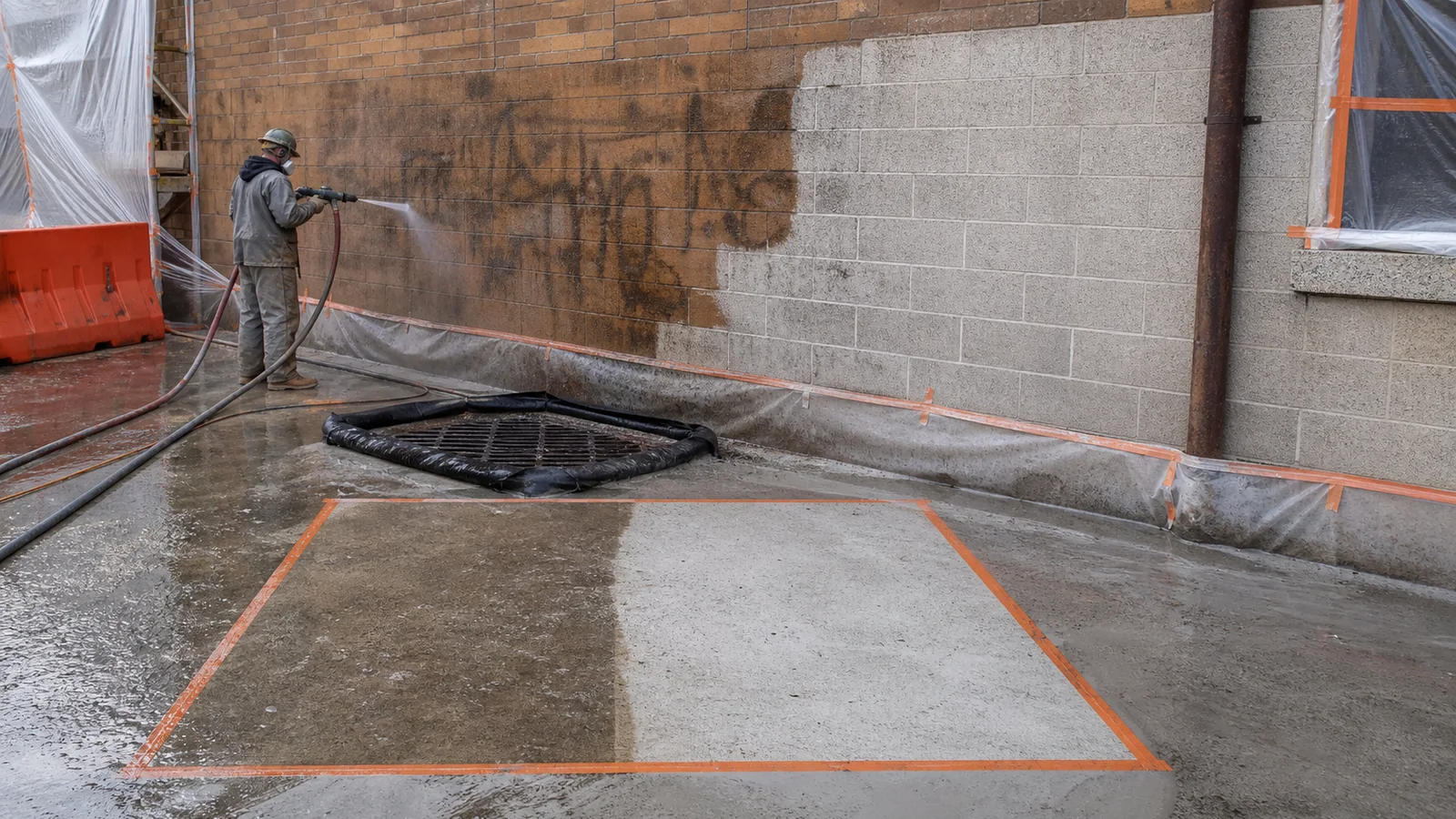
Fast action after graffiti can reduce the time a marking remains visible, but speed should not replace a substrate check. An aggressive process that clears paint from hard concrete may permanently texture soft brick, cut mortar joints, dull a coated metal panel, or leave a conspicuous clean patch on an aged wall. The right commercial response balances removal, appearance, access, and site controls.
Manases EcoBlast provides mobile wet abrasive blasting and surface preparation for property teams, contractors, facilities, and public works across Kansas, Oklahoma, and Texas, with operating bases in Great Bend and Austin. Wet abrasive methods are one option within a substrate-specific plan; they reduce airborne dust compared with dry blasting but are not dust-free.
Document the incident before disturbing it
Property managers should first follow their organization’s reporting, insurance, and law-enforcement procedures. Photograph the full elevation, close views of the marking, nearby damage, and any relevant access points before cleanup. Preserve recordings or other evidence according to the organization’s policy. Removal crews should not be expected to decide when evidence is no longer needed.
Record when the graffiti was discovered, the apparent marking material, approximate dimensions, height, and substrate. Note whether the surface has a coating, sealer, historic character, existing staining, cracks, or previous cleaning patches. Include nearby windows, signs, landscaping, vehicles, electrical equipment, pedestrians, traffic, drains, and waterways in the site notes.
If the marking contains threatening or hateful content, the site owner may prioritize rapid screening. Temporary opaque covering can limit visibility while reporting and removal are coordinated, provided the covering itself will not damage the surface or interfere with evidence procedures.
Match removal to the substrate
“Graffiti” may be aerosol paint, marker, ink, adhesive, chalk, or a combination. Each interacts differently with porous and nonporous materials. A test area should determine whether the marking can be removed without creating damage more noticeable than the original vandalism.
Brick and mortar: Fired brick ranges from hard and dense to soft or weathered. Mortar is often more vulnerable than the brick face. Excessive pressure or an unsuitable abrasive can erode joints or remove the fired face, changing color and water behavior. Historic or fragile masonry calls for specialist review.
Concrete and concrete masonry: Dense formed concrete may tolerate a different approach than architectural precast or porous concrete block. Form liners, exposed aggregate, pigments, sealers, and prior repairs can make results uneven. Cleaning can reveal a lighter “shadow” because the surrounding wall remains weathered.
Natural stone: Limestone, sandstone, granite, and other stones differ greatly in hardness and porosity. Do not assume a process suitable for granite is acceptable on limestone. Character-defining or historic stone should be evaluated under the applicable preservation requirements.
Painted metal and coated panels: Removal may affect the factory or field-applied coating beneath the graffiti. If preserving that finish is not feasible, the practical scope may be controlled preparation followed by repainting an entire panel or defined break line.
Wood, glass, plastics, and signs: These can scratch, etch, raise grain, or lose printed and reflective finishes. They require separate evaluation and are frequently excluded from abrasive work.
Test the least conspicuous representative area
A small test should be performed where it represents both the marking and substrate while remaining visually discreet. Begin with the least aggressive viable combination of process variables, then increase only as needed. Review the sample after the surface has dried; wet masonry can hide shadows, color shifts, and texture changes.
The owner’s representative should decide what result is acceptable. Complete pigment removal may not be possible without unacceptable substrate loss. In other cases, a faint shadow can be less noticeable than a sharply cleaned rectangle. Expanding treatment to a natural architectural boundary—or cleaning a broader panel—may create a more uniform appearance.
Document the accepted test with close and contextual photographs. For large or prominent elevations, consider more than one sample because masonry condition and paint buildup can vary. If the substrate deteriorates during testing, pause and involve the appropriate masonry, coating, or preservation professional.
Control water, residue, and public access
Commercial graffiti often occurs exactly where site control is difficult: storefronts, alleys, parking structures, schools, retaining walls, and roadside assets. The work plan should address pedestrian detours, traffic, work hours, overspray, noise, lighting, hose routing, and separation from occupants.
Protect windows, doors, cameras, signs, vehicles, landscaping, and adjacent finishes. Identify storm drains, floor drains, soil, and surface-water pathways before work begins. Establish containment and recovery measures suited to the marking, substrate, removal method, and applicable site requirements. The fact that water is used does not make runoff harmless or suitable for discharge.
Existing coatings or the graffiti itself may contain constituents that affect worker protection and waste handling. Unknown materials, older coatings, or sensitive sites may require testing before disturbance. Agree in advance who supplies barricades, drain protection, water access, waste containers, traffic control, and after-hours security.
Plan for occupied and sensitive properties
At an occupied facility, coordinate with security and operations before setup. Confirm who can close sidewalks or parking spaces and who communicates with tenants, parents, customers, or employees. Avoid directing mist or residue toward entrances, outdoor air intakes, open windows, food-service areas, or active loading zones.
Municipal and public-facing work may require permits, right-of-way coordination, or approved traffic controls. Schools, healthcare sites, historic properties, and water-adjacent locations may impose additional constraints. These should be identified during scoping rather than discovered after a crew arrives.
Cleanup should be part of acceptance. Inspect ledges, joints, pavement, nearby glass, and landscaping—not only the treated wall. Remove masking and controls in a sequence that does not release collected residue. Reopen the area only after the owner or controlling contractor confirms it is ready.
Reduce the visibility of future incidents
After removal, the owner may consider an anti-graffiti coating, improved lighting, cameras, landscaping, or changes to access. Sacrificial and permanent coating systems have different appearance, maintenance, and reapplication requirements. Compatibility with the substrate and future cleaning method should be confirmed with the coating manufacturer.
Keep a response record with baseline photos, accepted test settings, substrate notes, access contacts, drain locations, and the treatment boundary. If the same property is marked again, this information can shorten planning without eliminating the need to check the new marking and current substrate condition.
Avoid assuming that sealing is always beneficial. Some masonry assemblies need to manage vapor and moisture, and an incompatible treatment can change appearance or trap moisture. The designer, preservation professional, or coating manufacturer should guide that decision where relevant.
Frequently asked questions
Can graffiti be removed from brick without changing it?
Sometimes, but results depend on brick hardness, mortar condition, paint penetration, and prior treatments. A dried test area is the safest basis for deciding.
Does wet abrasive removal create no dust?
No. It reduces airborne dust compared with dry blasting, but controlled access, PPE, masking, containment, and cleanup are still needed.
Will the cleaned area match the rest of the wall?
Not always. Weathering, staining, pigment shadows, and prior cleaning can create variation. Treating to an architectural break may improve visual uniformity.
How quickly can a commercial site be assessed?
Photos often support initial scoping. Prominent, fragile, historic, unknown, or access-constrained surfaces may require an on-site test before a production plan is set.
Request a substrate-aware removal plan
Send Manases EcoBlast photos or site plans, the property ZIP code, approximate marked area and wall dimensions, and the required timeline. Include close-ups, full-elevation views, substrate or coating information, access hours, drain locations, and public-control requirements. Call 512-592-1288 or email contact@manasesecoblast.com to discuss commercial graffiti removal in Kansas, Oklahoma, or Texas.
Suggested next reads: