
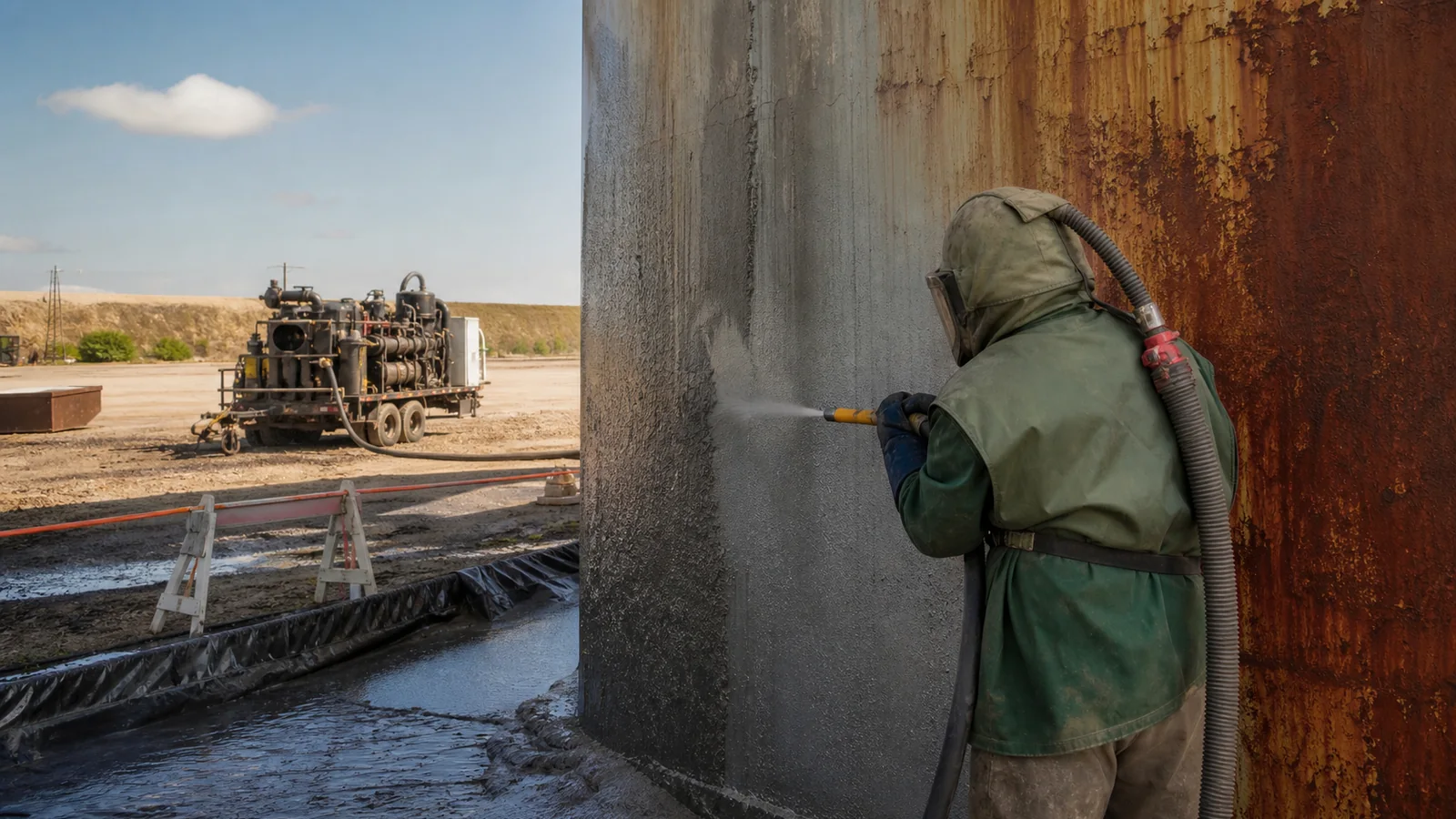
“Dustless blasting vs. sandblasting” sounds like a simple equipment comparison, but commercial surface preparation rarely has a universal winner. Wet abrasive blasting introduces water into the abrasive stream to suppress airborne dust. Traditional dry abrasive blasting uses compressed air and dry media. Both can remove coatings, corrosion, and scale, and both can prepare surfaces for new protective systems when properly specified.
The best method depends on the substrate, coating, target profile, work environment, containment strategy, schedule, and what happens immediately after cleaning. It also helps to clarify terminology: wet abrasive blasting is commonly marketed as dustless blasting, yet it is not dust-free. “Sandblasting” is often used loosely for dry abrasive blasting even when the abrasive is not silica sand.
How the Two Processes Differ
Dry abrasive blasting accelerates media through a nozzle using compressed air. The impact fractures or dislodges the unwanted material and can create an anchor profile in steel. The process can be highly productive, but it typically creates airborne particulate that must be managed with containment, ventilation, respiratory protection, and housekeeping controls appropriate to the work.
Wet abrasive blasting mixes water with abrasive media before or near the nozzle. Water adds mass and captures a portion of the dust generated at impact, reducing the amount that becomes airborne. The work zone can have better visibility and less drifting particulate, but the process produces wet spent media and coating debris that still require collection.
Neither method changes the basic need to understand the existing coating. If lead or another regulated constituent is present, the project still requires suitable exposure controls, containment, waste characterization, and disposal. Adding water does not neutralize hazardous material.
Airborne Dust, Mist, and Site Separation
Wet blasting’s primary operational advantage is dust suppression. This can be valuable around neighboring properties, parked vehicles, occupied facilities, or outdoor sites where wind complicates dry containment. Reduced airborne dust may also limit the area affected by drifting particulate.
That advantage should not become an absolute claim. Wet blasting can release fine particles, mist, and rebound. Screens, ground protection, exclusion zones, and personal protective equipment may still be required. Sensitive intakes, electronics, process lines, and finished surfaces need protection from moisture and debris.
Dry blasting can be a sound choice inside a properly designed enclosure or where robust containment and dust collection are already available. In those settings, keeping water out of the process may simplify material handling or align better with the facility’s established workflow.
For locations in Kansas, Oklahoma, and Texas, wind and weather deserve early consideration. Outdoor conditions can change the practical containment plan for either method, even when the underlying specification remains the same.
Surface Condition and Coating Readiness
Both wet and dry methods can achieve high levels of cleanliness and create a coating profile. Results depend on media hardness and size, pressure, nozzle technique, coating condition, and substrate—not merely whether water is present.
Dry blasting leaves a dry surface, which can simplify rapid inspection and priming. However, dry-blasted steel can still rust if exposed to humidity or contaminants. Wet-blasted carbon steel has an additional flash-rust concern because water contacts the newly exposed metal. The schedule must account for rinsing when appropriate, drying, inspection, and coating within the approved window.
Some specifications permit an approved inhibitor, while others restrict additives due to compatibility concerns. The coating manufacturer and project specification should govern. A contractor should not introduce a chemical simply because it is routinely used on other jobs.
Wet blasting can help wash soluble residue from a surface, but it does not prove that contaminants are absent. Where coating performance depends on salt or cleanliness limits, use the inspection and testing procedures identified by the project.
Cleanup and Waste Management
Dry blasting produces dry spent abrasive mixed with removed coating. Depending on containment and media, it may be swept, vacuumed, or recovered through a blast-room system. Fine dust can migrate into cracks and equipment, so isolation and post-work cleaning can be significant.
Wet blasting produces damp abrasive, paint chips, and water. The heavier waste often stays closer to the work, but collection can involve berms, ground covers, filtration, wet vacuuming, or other controls. Runoff must not be allowed to enter storm drains or soil without an approved plan.
Waste classification depends primarily on what was removed and applicable requirements, not on whether the blasting stream was wet or dry. Owners should identify who will sample, profile, containerize, transport, and document disposal. Those duties belong in the commercial scope rather than being assumed after production begins.
Productivity, Access, and Operational Constraints
Production rates vary widely. Thick coatings, complex geometry, deep corrosion, small nozzles, restricted access, and a demanding cleanliness standard can slow either approach. An open steel plate is not comparable to a lattice structure filled with bolts and corners.
Wet blasting may reduce time devoted to broad dust containment in some outdoor situations, while adding water collection and drying steps. Dry blasting may move efficiently inside a blast enclosure, while requiring more extensive dust control in an open plant. The useful comparison is total project workflow: mobilization, masking, containment, blasting, cleanup, inspection, and coating turnover.
Water availability can influence wet work. Facility rules may also prohibit introducing moisture near energized systems, food production, or sensitive instrumentation. Conversely, dry dust may be unacceptable near air intakes or operating tenants. A site walk or detailed photo review helps expose these constraints.
How to Select the Right Method
Begin with the finish requirement. Identify the substrate, current coating, required cleanliness, specified profile, and planned coating. Then map site risks such as occupancy, wind, drains, equipment, traffic, and adjacent finishes. This approach prevents the process name from becoming the specification.
A representative test patch can confirm removal behavior and appearance. It is particularly valuable on thin steel, masonry, historic fabric, mixed substrates, and unknown coating systems. The test area should use the proposed media and operating range and should be reviewed by the person authorized to accept the work.
Commercial bids should state assumptions about access, work hours, utilities, containment, masking, waste, and post-blast coating. Comparing those assumptions often reveals more than comparing a wet-blasting rate with a dry-blasting rate.
Frequently Asked Questions
Is dustless blasting safer than sandblasting?
No process is automatically safe. Wet blasting reduces airborne dust, but hazards can include rebound, noise, high-pressure equipment, mist, contaminants, and wet waste. The correct controls depend on the coating, abrasive, site, and applicable safety requirements.
Does wet blasting damage metal?
It can affect a surface if the media, pressure, or technique is too aggressive. Properly selected settings can clean many steel assets effectively. Thin panels, soft metals, edges, and precision components deserve testing and careful control.
Which method gives paint better adhesion?
Either can produce a suitable surface when it meets the coating system’s cleanliness and profile requirements. Adhesion depends on verified preparation, contamination control, compatible materials, and timely application—not the marketing name of the blasting method.
What should we send for an initial review?
Provide current photos, available plans, the ZIP code, estimated dimensions or square footage, coating and substrate information, desired finish, access notes, and the target timeline. Include any test reports or coating specifications already available.
Discuss a Commercial Surface-Preparation Scope
Manases EcoBlast works with commercial teams from Great Bend and Austin throughout Kansas, Oklahoma, and Texas. For a method review, send photos, plans, project ZIP code, approximate size, and schedule to contact@manasesecoblast.com, or call 512-592-1288. The team can evaluate the work area, removal objective, containment considerations, and coating handoff before defining the next step.